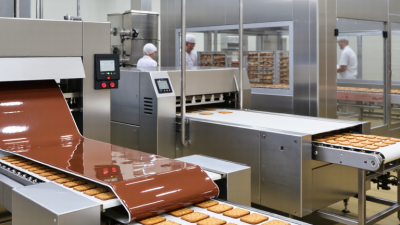
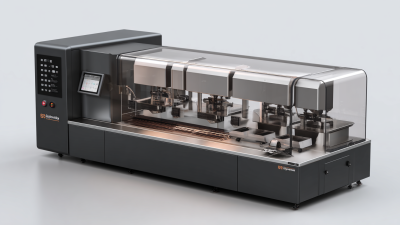
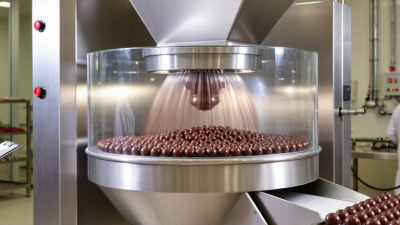
Choosing a Chocolate Enrobing Machine is a practical decision about product quality, line capacity, and daily operating demands. Grand View Research estimated the global chocolate market at USD 119.39 billion in 2023 and projected growth through 2030. That signals opportunity, not a guarantee of sales. A coating line still has to match the product and the factory.
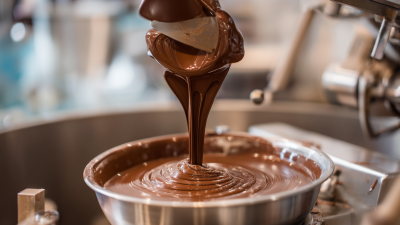
Chocolate’s behavior explains why machine details matter. Food engineer and chocolate-science author Dr. Richard W. Hartel describes chocolate as “a suspension of solid particles in a continuous fat phase.” For enrobing, that mixture must flow evenly, cover the product, and set with a consistent finish. The right machine depends on more than its advertised output. Check belt width, coating control, tempering compatibility, cooling capacity, cleaning access, and available floor space. Ask how the equipment handles your actual product, not just a sample chosen for a demonstration. Small details count. A thin biscuit and a soft filling can behave very differently under the same curtain of chocolate.
This guide compares the features that affect production and product consistency. It also considers maintenance, operator needs, and room for future capacity. Some figures on supplier pages are difficult to compare directly, so treat headline throughput with care. A factory trial is useful. So is a little skepticism. The best choice is the machine that performs reliably with your recipe, your team, and your production schedule.
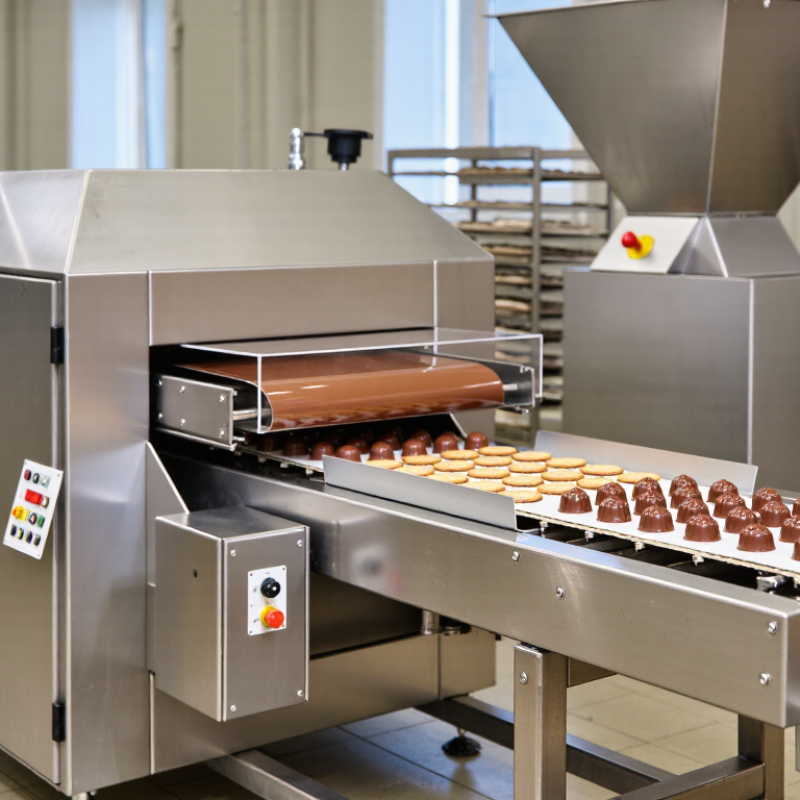
Before comparing chocolate enrobing machines, define what your production line must handle. List each product’s dimensions, shape, and center type, such as biscuits, bars, or soft fillings. Record your target output per hour and expected seasonal peaks. Small details matter. A narrow product may need different belt spacing than a broad slab, while delicate centers may require gentler handling. Decide whether you need a thin coating, full coverage, or a controlled chocolate layer on the bottom.
Tips: Measure several batches, not just one ideal sample. Note chocolate temperature, room conditions, and coating weight during a normal shift. These figures give suppliers useful requirements and help you compare equipment fairly.
Think about your goals beyond speed. Do you need quick product changeovers, a compact footprint, or less chocolate waste? Check whether the machine can maintain an even curtain across your actual product width. Ask about cleaning access and routine adjustment points; a hard-to-reach scraper can slow a busy line. If possible, test your products before choosing. A neat sample run is helpful, but it may not reflect a full shift. Plans change. Leave room for realistic growth, without paying for capacity your team cannot use.
Use the planning examples below to define requirements before comparing machine specifications. Throughput figures are calculations, not guaranteed machine capacities.
| Planning Dimension | Example Data or Calculation | What to Define | Enrober Selection Implication |
|---|---|---|---|
| Required daily output | For an 8-hour shift with 7.2 productive hours, 500 kg per shift requires about 69 kg/h; 1,000 kg requires about 139 kg/h. | Target kilograms per shift or day, number of shifts, and planned cleaning or changeover time. | Compare required net output with tested line capacity, allowing for actual operating losses and product changeovers. |
| Piece rate and product weight | At 40 g per piece and 60 pieces/min, product flow is 144 kg/h: 0.040 kg × 60 × 60. | Pieces per minute and the average weight of each center before enrobing. | Check that the feeder, belt, curtain, and cooling section can handle the required piece rate consistently. |
| Product size and spacing | Record the minimum and maximum length, width, height, and spacing of centers. For example, a 30 mm-wide center with a 10 mm side gap occupies about 40 mm of belt width per lane. | Product dimensions, shape variation, orientation, and the number of lanes needed. | Use the actual product layout to establish usable belt width; nominal belt width alone does not determine lane capacity. |
| Coating pickup | A 40 g center with a 25% coating pickup gains 10 g of chocolate and exits at approximately 50 g, assuming pickup is measured against center weight. | Target coating weight or percentage, acceptable variation, and whether the base is fully or partially coated. | Specify curtain control, bottoming or enrobing options, blower and vibration adjustments, and a method for checking coating weight. |
| Enrobing goal | Possible goals include full coverage, a defined bottom coat, a thinner shell, or a consistent finish across multiple product shapes. | Required coverage, appearance, texture, and acceptable coating-weight range for each product. | Request a product trial using representative centers and coating; evaluate coverage and finished-product quality, not speed alone. |
| Coating and temperature control | Tempered chocolate requires controlled handling of temperature and flow. The appropriate operating temperatures depend on chocolate type and formulation. | Chocolate type, viscosity behavior, tempering method, and expected production duration. | Confirm compatibility with the coating and tempering process, along with accessible controls and temperature monitoring. |
| Cooling requirements | Cooling performance depends on the product, coating load, belt loading, airflow, and room conditions; a single cooling time is not suitable for every product. | Product exit condition, coating firmness, available floor length, ambient conditions, and required line speed. | Match the cooling tunnel and belt speed to trial results; verify that products release and handle correctly at the discharge. |
| Changeovers and cleaning | A line making several product sizes or coating types needs time for adjustment, cleaning, and temperature stabilization between runs. | Products per day, changeover frequency, cleaning procedure, and available labor. | Assess removable parts, access for cleaning, setup adjustments, and the effect of changeover time on daily output. |
| Site and line integration | The complete installation may include product feeding, enrobing, cooling, and discharge equipment, each requiring space and appropriate utilities. | Available floor area, ceiling height, electrical supply, ventilation, access routes, and connections to upstream and downstream equipment. | Review the full line layout and utility requirements before confirming machine dimensions or capacity. |
Planning note: confirm performance with trials using your actual centers and coating. Calculate required mass throughput as piece weight × pieces per minute × 60, and include realistic allowances for downtime and changeovers.